




The Three Attachment Systems in Body Jewelry
Every piece of barbell-style body jewelry connects to its decorative end in one of three ways: internal thread, external thread, or threadless (push-fit). For wholesale buyers the choice drives price, perceived quality, return rates and — critically — whether professional studios will stock your line. This guide explains exactly how each system works and when to buy which.
Internal Thread: The Studio Standard
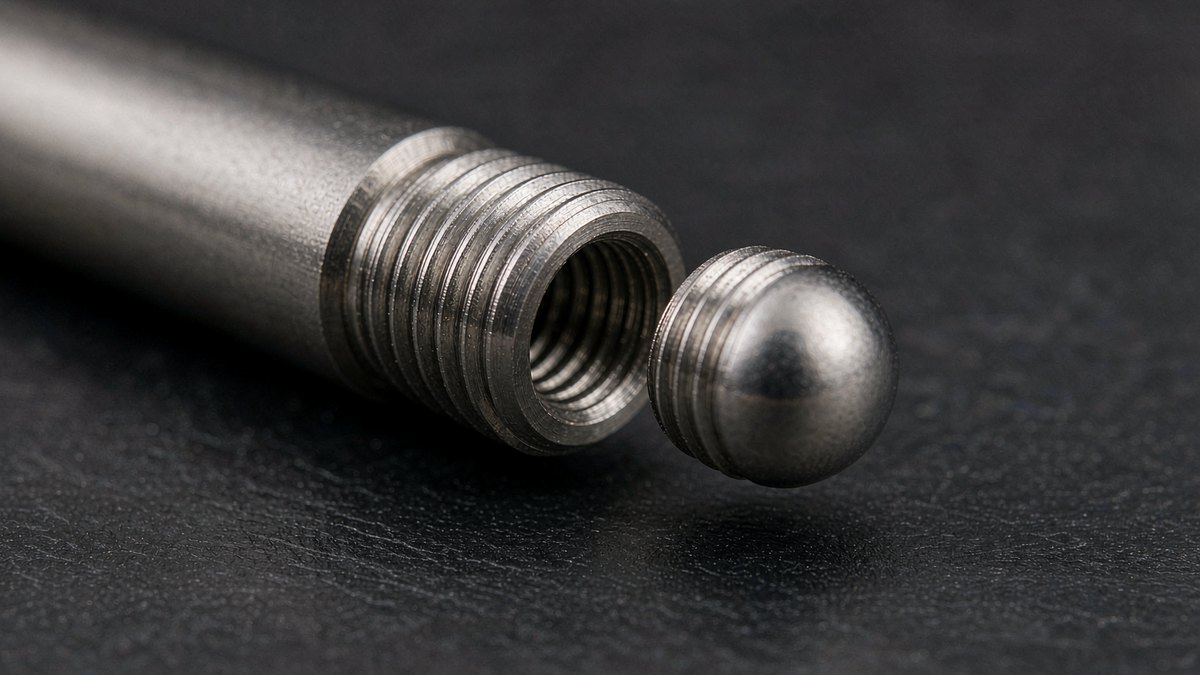
In an internally threaded barbell, the screw is inside the bar: the post has a tapped (threaded) hole at its end, and the decorative end carries the screw pin. The visible surface of the post is completely smooth.
Advantages
- No exposed threads touch tissue. This is why the APP accepts internal thread for initial piercings — threads passing through a fresh channel shred tissue and harbor bacteria.
- Smooth polish from end to end. Nothing snags on clothing, towels or hair.
- Premium feel. The tactile “click” of a well-machined internal thread is a major part of why studios charge more for this jewelry.
Drawbacks
- Higher machining cost — the bar must be drilled and tapped on precision equipment.
- Threads can loosen over months of wear; buyers should be told to check tightness periodically.
Our entire line of straight barbells, curved barbells and labret studs is internally threaded in ASTM F136 titanium, machined to consistent thread engagement so ends do not wobble.
External Thread: Cheap, and You Can Tell
External threading means the screw is on the outside of the bar: the post tip is threaded, and the end screws onto it.
Why it survives in the market
- Lowest manufacturing cost — no tapping operation, simpler tooling.
- Fine for costume and healed-only fashion jewelry sold at entry price points.
Why professionals reject it
- Exposed screw threads pass directly through the piercing channel when inserting — painful on fresh piercings, damaging on fragile tissue.
- The thread crevices collect biofilm and are nearly impossible to sterilize fully.
- Threads wear out; ends loosen and get lost, generating complaints.
We manufacture no external-thread jewelry. The margin you save at purchase, you repay in returns and reputation.
Threadless (Push-Fit): The Modern Favorite
Threadless jewelry has no threads at all. The end carries a small, slightly bent pin; the post has a precisely bored hole. You push the pin in and friction holds it. To remove, you pull — studios use a slight twist-and-pull motion.
Advantages
- Infinitely interchangeable. One post, dozens of tops — the strongest upsell engine in the industry. Customers who buy one threadless labret typically return for more ends.
- Perfectly smooth, no screw to loosen. Nothing rotates loose from daily movement.
- Flush seating. Tops sit tight against the post with no gap.
- Fast to change — no screwing with numb fingers.
Drawbacks
- Retention is friction-based: very large or heavy dangle ends can pop off if the pin fit is loose.
- Pins and posts must be matched by gauge (20G, 18G, 16G) and manufacturing tolerance — mixing brands can result in loose or unseatable ends.
Our replacement tops and bases category is built around threadless interchangeability: pins are bent to a uniform angle and hardness so any TitanPierce end seats firmly on any TitanPierce post of the same gauge.
Side-by-Side Comparison
| Internal thread | External thread | Threadless | |
|---|---|---|---|
| Fresh-piercing safe | Yes (APP-accepted) | No | Yes (APP-accepted) |
| Surface touching tissue | Smooth | Threaded | Smooth |
| Top interchangeability | Good (thread-matched) | Poor | Excellent |
| Retention of heavy ends | Excellent | Fair | Good (fit-dependent) |
| Wholesale cost | Medium | Low | Medium |
| Best for | Barbells, nipples, tongue, navel | Budget fashion lines | Labrets, nostril, cartilage, upsell systems |
What to Stock: A Practical Mix
For a balanced wholesale assortment, we recommend roughly:
- 50–60% internal thread — barbells, curved barbells, horseshoes, navel and nipple work where retention matters most. Start with our straight & curved barbell bases.
- 30–40% threadless — labrets, nostril and cartilage positions, where the interchangeable-top system drives repeat sales of loose tops.
- 0% external thread — unless you deliberately serve a rock-bottom price segment, the complaint cost is not worth it.
If you sell to studios, weight further toward threadless — it is the system that keeps customers returning to the studio rather than a marketplace, which is exactly the story studios want to hear from their wholesaler.
Frequently Asked Questions
Is threadless as secure as threaded jewelry?
For everyday wear and standard top sizes, yes. For heavy dangle ends or high-movement placements like tongues, internal thread is more secure. Match the system to the placement.
Why does my threadless end feel loose?
Either the pin and post are from different tolerance systems, or the pin’s bend has flattened. TitanPierce pins can be re-bent slightly by a piercer to restore friction fit.
Can I mix threadless tops between brands?
Sometimes, but not reliably — pin diameter and hole tolerance vary by maker. Sticking to one manufacturer’s system guarantees fit; ours is consistent across the entire catalog.
Are internally threaded bars harder to screw on?
They take a few extra seconds and require aligning the pin with the tapped hole, but quality machining makes it smooth. Selling instructions with each piece eliminates most support questions.
Which system is best for wholesale margins?
Threadless, decisively — because the post is a one-time sale that anchors ongoing top purchases. Build your labret and nostril lines on threadless bases and merchandise tops alongside. See our wholesale terms for mixed-MOQ pricing on tops and posts.
The Bottom Line
Internal thread is the baseline of professional credibility, threadless is the engine of repeat revenue, and external thread is a cost decision you will regret. Every TitanPierce piece — navel rings included — uses internal thread or threadless connections in ASTM F136 titanium, so your customers get studio-grade hardware at wholesale prices.