




Why Nose and Septum Sizing Goes Wrong in Wholesale
Nose jewelry is the highest-return category in body piercing wholesale — not because of quality complaints, but because of wrong gauge and wrong diameter. A buyer who orders 18G nostril studs for a market that wears 20G, or 10mm hoops for customers who need 8mm, ends up with dead stock. This guide gives you the sizing data our factory works with, so your next purchase order is right the first time.
Gauge (Thickness) Chart: US vs EU Conventions
Gauge numbers run backwards: a smaller number is a thicker post. Studios in the US pierce noses primarily at 18G and 16G; studios in Europe and much of Asia use 20G–18G. Septum piercings are almost always started at 16G and can be stretched to 14G, 12G and beyond.
| Gauge | Thickness (mm) | Typical use |
|---|---|---|
| 20G | 0.8 mm | Fashion nostril studs (EU default), thin nostril anatomy |
| 18G | 1.0 mm | Most common nostril stud gauge in the US |
| 16G | 1.2 mm | Standard septum starting gauge; chunkier nostril studs |
| 14G | 1.6 mm | Stretched septum, statement rings |
| 12G | 2.0 mm | Heavily stretched septum |
| 10G | 2.5 mm | Largest common septum size; CBR and circular barbell territory |
Wholesale tip: if you serve a mixed market, the safest opening assortment is 20G / 18G / 16G in roughly equal quantities for studs, and 16G / 14G for septum rings. Our nose studs and rings collection is filterable by gauge so you can build exact ratios.
Nostril Stud Wearable Lengths
For L-bend and nose-bone studs, “length” means the vertical post that sits inside the nostril:
- 6 mm (1/4″): very thin nostrils; common in EU fashion lines.
- 6.5 mm: the standard for most anatomy and the safest single-length buy.
- 7 mm: slightly thicker tissue or swelling margin.
- 8 mm (5/16″): thick nostrils, or piercings placed deeper in the crease.
For flat-back labret posts used in nostrils, the same logic applies with a 0.5–1 mm shorter post because the flat disc sits flush. See our dedicated labret post length guide for the full millimeter matrix across all placements.
Septum and Hoop Diameter Chart
Diameter for rings and clickers is the internal measurement, taken at the widest point:
| Diameter | Look / use case |
|---|---|
| 6 mm | Snug hugging fit; popular for small septum anatomies and nostril hoops |
| 8 mm (5/16″) | The universal septum default — fits most piercings comfortably |
| 10 mm (3/8″) | Relaxed fit, room for swelling, most common nostril hoop size |
| 11 mm–12 mm | Loose drape, statement clickers, vertically elongated septum anatomy |
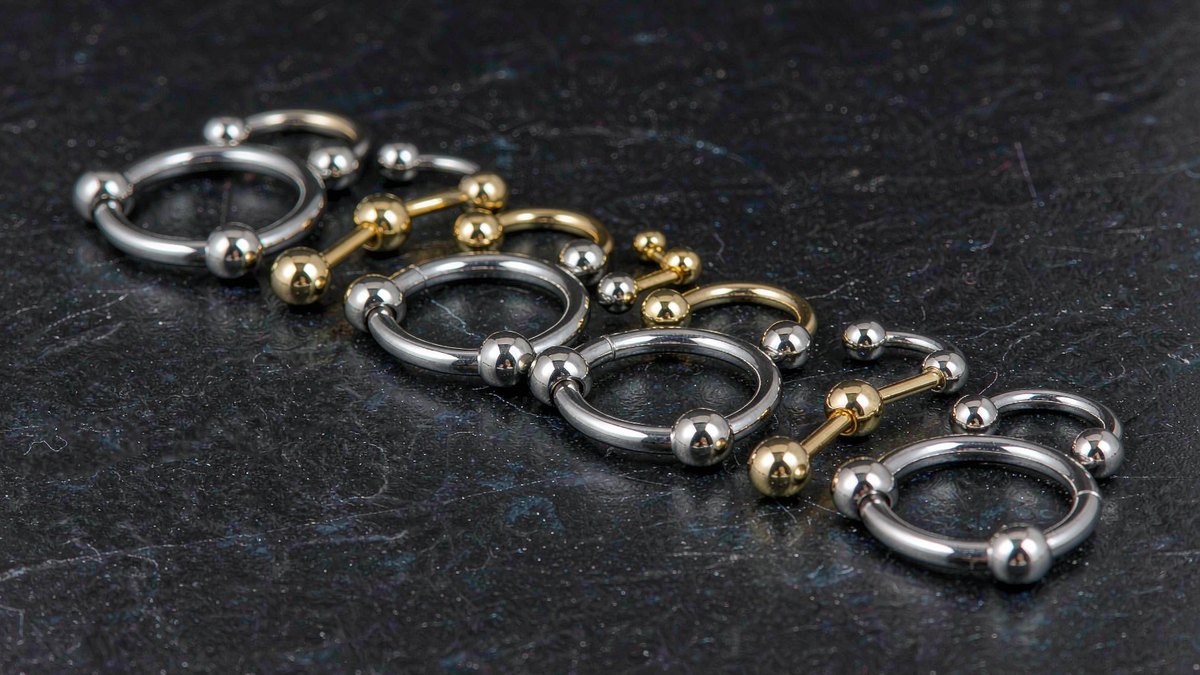
Wholesale tip: an 8/10 mm two-size strategy covers roughly 90% of septum customers. For nostril hoops, 8/10 mm in 20G–18G is the equivalent. Our septum clickers and hoops category includes hinged clickers, seamless rings and captive bead rings across this full diameter range in ASTM F136 titanium.
Matching Ends and Tops to Gauge
Thinner gauges limit the top size you can safely sell:
- 20G: tops up to 2.5–3 mm (small prong CZ, 2 mm balls) — anything larger looks unstable and snags.
- 18G: tops 2–3.5 mm; the sweet spot for bezel-set CZ and 3 mm opals.
- 16G: tops 3–5 mm; full range including cluster and dangle ends.
- 14G: 4–6 mm and beyond; this is where large bezels and sculpted ends belong.
If you buy replacement tops and parts, note that threadless pins are gauge-specific — a 20G pin will not seat firmly in an 18G receiving post. Mixing gauges in one order without labeling is a classic warehouse error; keep pins and posts bagged by gauge.
Converting Gauge to Millimeters (Quick Reference)
US customers speak in gauge, EU customers in millimeters. Print this for your sales team: 20G = 0.8 mm, 18G = 1.0 mm, 16G = 1.2 mm, 14G = 1.6 mm, 12G = 2.0 mm, 10G = 2.5 mm, 8G = 3.2 mm. When a customer asks for “1 mm septum rings,” that is 18G — but for septum, confirm they did not mean 16G (1.2 mm), the actual standard.
Frequently Asked Questions
What gauge do most nose piercings start at?
US studios most commonly pierce at 18G, EU studios at 20G–18G. Septum piercings start at 16G in nearly all markets.
Is a 6 mm or 8 mm septum ring better?
8 mm fits the majority of septum piercings. 6 mm suits smaller anatomies or a tight, tucked look, but returns are higher because it is unforgiving if the piercing sits even slightly low.
Can I wear a 16G stud in an 18G piercing?
Not without stretching. Jewelry must match or be slightly larger than the healed channel. Sizing down is impossible; sizing up requires tapering by a piercer.
How do I measure a hoop I already own?
Measure the internal diameter with a ruler or caliper across the widest inside point, and measure the wire thickness for gauge. Two numbers — diameter and gauge — fully specify a ring.
What sizes should a first wholesale order include?
For studs: 20G/18G/16G at 6.5 mm. For rings: 16G at 8 mm and 10 mm. This core covers most demand; expand into 14G and decorative diameters as your sales data grows.
Build the Assortment With Confidence
Every product page in our nose and septum categories lists gauge, wearable diameter and top size in millimeters and gauge notation, so mixed-market buyers never misinterpret. Combine this chart with our wholesale program — 10-piece minimums per style, mix any sizes — and you can stock a complete, correctly-proportioned nose wall without over-committing capital.