



Why the Coloring Method Matters More Than the Color
Two gold-tone rings on a shelf can look identical — and behave completely differently. One is anodized titanium: its color is a transparent oxide layer grown out of the metal itself. The other is plated steel or brass: a thin layer of another metal deposited on the surface. The first keeps its color for the life of the jewelry; the second eventually scratches, wears through or flakes. For wholesale buyers, knowing the difference is the difference between repeat customers and refund requests.
How Anodizing Works
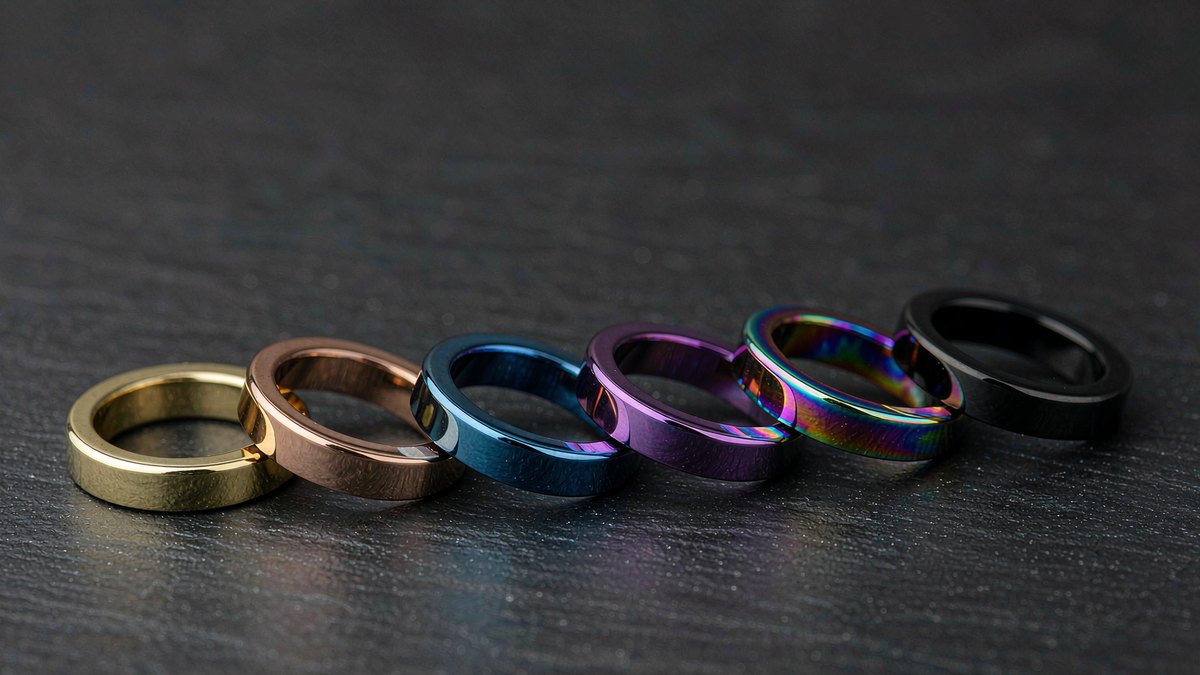
Anodizing is an electrochemical process: the titanium piece is immersed in an electrolyte and a controlled voltage is applied. Oxygen ions grow an oxide layer on the surface — typically 30–300 nanometers thick. The layer is transparent, and it creates thin-film interference: light waves reflecting off the top and bottom of the oxide cancel and reinforce each other by wavelength. Different voltages produce different layer thicknesses, and therefore different colors.
- ~15–20 V → yellow / gold
- ~25–30 V → purple / violet
- ~30–35 V → blue
- ~35–40 V → light blue / cyan
- ~55–60 V → greenish / teal
- ~90 V+ → rainbow or simmered multicolor (gradient voltage)
What this means in practice
- No pigments, no lacquer, no coating. Nothing can chip off because the color is the metal surface.
- Wear-through is impossible in normal use — the layer is as hard as the titanium beneath it.
- Colors are permanent through washing, swimming and sanitizing chemicals.
- Exact voltage = exact color, so production batches are repeatable — critical when a customer reorders “the same purple.”
Every colored piece in our nose and septum, navel and barbell ranges is anodized ASTM F136 titanium — no paint, no PVD on colored SKUs.
How PVD and Electroplating Work — and Why They Fail
PVD (Physical Vapor Deposition)
PVD deposits a micro-thin film (often titanium nitride for “gold”) onto the jewelry in a vacuum chamber. Quality PVD on a good substrate can be quite durable — this is legitimate technology, and it is how gold-tone steel is made. But it is still a coating with a finite thickness (1–4 µm):
- Friction at contact points (threads, the inside of hoops) wears it to a shiny ring of raw substrate.
- Once a scratch exposes the substrate, the visual difference makes the wear obvious.
- PVD adds cost per piece and cannot be touched up after sale.
Electroplating
Classic plating (gold, silver-tone over brass or steel) is the least durable option: 0.1–0.5 µm layers that wear through within weeks on high-contact jewelry. It survives in the market only because it is cheap. We do not sell plated jewelry.
Side-by-Side Comparison
| Anodized titanium | PVD coating | Electroplating | |
|---|---|---|---|
| Color source | Oxide layer of the metal itself | Deposited nitride film | Deposited metal film |
| Can chip/peel? | No | Wears at friction points | Yes, relatively quickly |
| Thickness | 30–300 nm, integral | 1–4 µm, added | 0.1–0.5 µm, added |
| Color range | Yellows, blues, purples, greens, rainbow | Gold, black, rose (limited set) | Broad (with lacquers) |
| Biocompatibility | Implant-grade throughout | Depends on substrate | Depends on substrate |
| Batch repeatability | Voltage-controlled, exact | Good | Variable |
Limitations of Anodizing to Know Before You Buy
Honesty about the boundaries helps your buyers set expectations:
- Anodizing cannot make true metallic gold. The “gold” is an interference yellow — warm and convincing in photos and on skin, but not electroplated-gold metallic. Customers wanting that exact mirror-gold metallic look need PVD or solid gold.
- Black is a special case. True black on titanium is usually a PVD or thermal-oxide process layered on the anodize. Our black SKUs use a durable dark film process on F136 — more wear-resistant than black coatings on steel, but worth stating as “coated black” in product copy.
- Anodized colors can shift slightly if exposed to certain autoclave cycles or harsh chemical cleaners over long periods — a consideration for studio sterilization workflows (see our sterilization guide).
Merchandising Color at Wholesale
- Lead with gold-tone. It is the top seller across every Western market and reads “premium” at titanium price points.
- Rainbow is a social-media multiplier. It photographs uniquely and is impossible to copy in plated lines.
- Keep a plain-silver base — a meaningful minority of customers reject all color.
- Name colors consistently. Use the same color names across your catalog (we do: Champagne Gold, Deep Purple, Ocean Blue, Rainbow) so reorders are frictionless.
Frequently Asked Questions
Does anodized color fade over time?
No. The oxide layer is part of the metal. Colors remain through years of wear, washing and swimming. Only aggressive chemical exposure (e.g. prolonged bleach contact) can slightly alter shade.
Is anodized titanium safe for sensitive skin?
Yes — the layer contains no added metals; it is oxidized titanium. F136 anodized jewelry remains nickel-free and implant-grade.
Can anodized jewelry be re-colored?
Yes. Stripping the oxide (a simple chemical or electrochemical step) and re-anodizing restores or changes the color — a service studios sometimes offer.
Why does PVD gold exist if anodizing is better?
For metals that cannot anodize colorfully (steel, brass) PVD is the only way to add gold tone. On titanium, anodizing is superior for durability and consistency; PVD black remains useful where true black is required.
Which colors should I stock first?
Gold-tone, black and rainbow in your best-selling base styles. They cover the majority of color demand and display beautifully together. Browse anodized options across the wholesale catalog.
The Bottom Line
Anodized titanium is the only coloring method where the color cannot wear off, because it is not on the jewelry — it is the jewelry. Build your color program on anodized F136, reserve coated black for where it is needed, and skip plated lines entirely. Your complaint rate will tell the story.