




What “Low MOQ” Should Actually Mean
Most body jewelry factories quote attractive unit prices, then anchor you with a 200–500 piece minimum per design — capital you spend before you know what sells. Real low-MOQ wholesale works differently: a small minimum per style (we use 10 pieces per design) that lets you buy breadth instead of depth. Ten designs × 10 pieces beats one design × 100 pieces every time in a fashion-driven category, because you learn what your market wants with 10% of the risk.
Our wholesale program is built on that principle: mix sizes, gauges and anodized colors freely within a design’s 10-piece MOQ, with tiered pricing that improves with total order value rather than per-SKU volume.
Step 1: Define Your Customer Before You Define Your Order
The same jewelry sells completely differently by channel:
- Professional studios: demand ASTM F136 titanium, internal thread or threadless, conservative gem sizes, and sizing breadth (see why material grade decides studio sales).
- Fashion/online retail: tolerates broader styles, prioritizes dangles, clusters and color; still benefits from titanium’s zero-complaint profile.
- Marketplace sellers: need fast-moving staples, images and shipping reliability more than exclusivity.
Write down which channel is 70%+ of your revenue. Every later decision — gauge ratios, style mix, price tier — follows from it.
Step 2: Build the Core Assortment
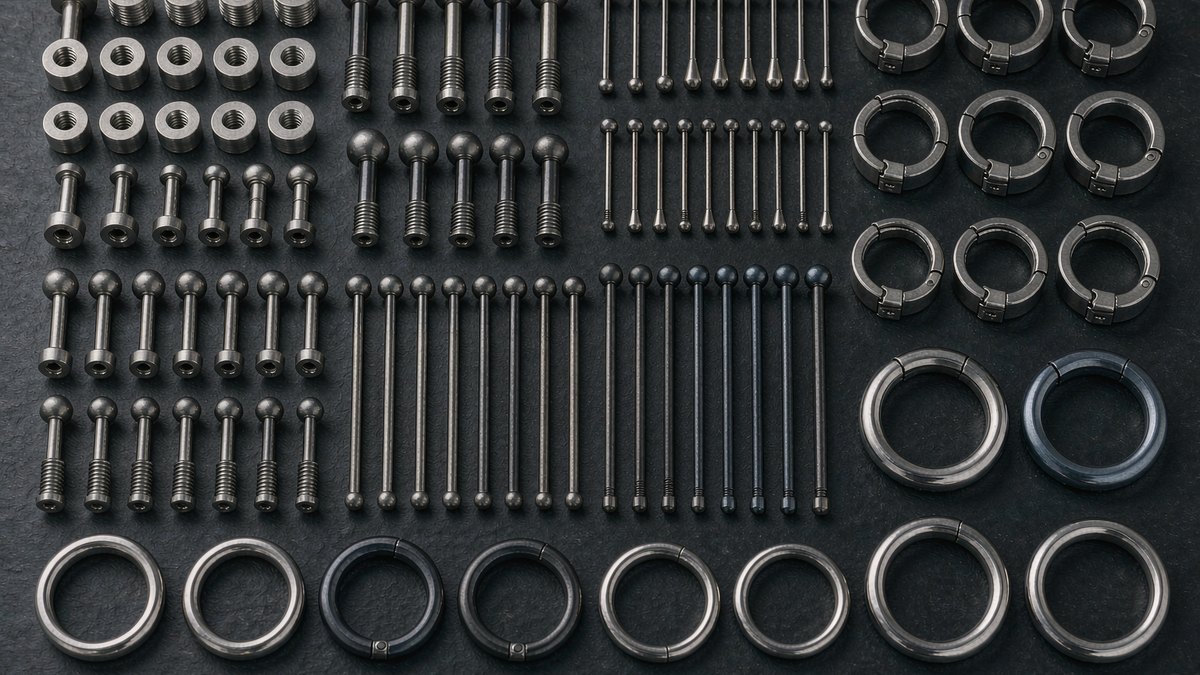
A complete body piercing wall needs fewer SKUs than buyers expect. The core spine:
| Category | Share of order | Notes |
|---|---|---|
| Labret / flat-back studs | 30% | 16G/18G/20G, 6–10 mm, threadless + internal thread |
| Nose & septum | 20% | 20G–16G studs, 16G hoops at 8/10 mm |
| Navel rings | 15% | All 14G, 10/12 mm — see the navel sizing guide |
| Barbells (straight/curved) | 15% | 14G/16G internal thread |
| Replacement tops & parts | 10% | The repeat-revenue engine — see loose tops |
| Other (dermals, nipple, genital) | 10% | Specialist demand, high margin |
Step 3: Read Price Tiers Correctly
Unit price is the least important number on a quote sheet. What matters:
- Price at your realistic volume, not the top tier. A tier you never reach is marketing, not pricing.
- Landed cost: unit + shipping + duties + payment fees. A $0.20 cheaper unit with a slow freight lane is often more expensive landed.
- Return rate × complaint cost: a supplier whose plating wears out costs you refunds and reviews. Implant-grade titanium’s near-zero complaint rate is a real, quantifiable discount (see anodized vs plated).
Step 4: QC Before Shipment, Not After
Insist on these from any supplier — including us:
- Thread gauge checks: ends must screw smoothly with no wobble on internal-thread bars.
- Threadless pin fit: push-fit should seat with friction, not fall under gravity.
- Stone security: prong-set CZ and opals should not shift under light thumb pressure.
- Anodize consistency: colored pieces in one batch must match each other.
- Documentation: material certificates for F136 claims — see how to verify in our material guide.
Step 5: Logistics Realities
- Dispatch time: in-stock wholesale should ship in 1–2 business days. If a supplier needs two weeks to “assemble” stock, it is drop-shipping, not warehousing.
- Tracking and insurance on every order, without you asking.
- Reorder speed: your best sellers will need restocking in 4–6 weeks. Choose a supplier whose replenishment cycle fits, and keep 20–30% reorder headroom in your budget.
Step 6: Plan for the Upsell Engine
The most profitable buyers in piercing are not one-time customers — they are customers who return for interchangeable parts. Structure your assortment so every threadless post you sell anchors future top purchases: merchandise CZ, opal and ball tops beside every post category, and price tops at accessible impulse levels. Studios do this instinctively; online retailers often forget it entirely.
Red Flags When Qualifying a Supplier
- “Surgical steel” with no ASTM specification stated.
- Prices far below market with no explanation (usually plating over brass, or G1/G2 titanium sold as G23).
- No material certificates on request.
- Product photos that all come from other brands’ websites.
- MOQ structures that punish small orders so heavily that testing new styles is impossible.
Frequently Asked Questions
Is 10 pieces per style really enough to wholesale?
Yes — that is the point of low MOQ. Breadth of assortment matters more than depth in piercing, and restocking is fast when you know what sells.
Can I mix different sizes within one design?
With us, yes: sizes, gauges and colors all count toward the same 10-piece MOQ. Confirm the same policy with any supplier before ordering.
What payment terms are normal?
Card/PayPal for first orders, with invoice terms possible once a relationship is established. Avoid suppliers demanding unusual payment channels.
How much should a first order be?
Enough to build the full core assortment table above at minimum depth: typically $500–1,500 at wholesale prices. That covers every category with room to learn.
What margin should I target?
3–5× on staples, 5–8× on dangles and clusters, 4–6× on replacement tops. Titanium’s premium over steel disappears at these multiples.
Start Simple, Reorder Often
The winning wholesale pattern is boring on purpose: a complete core assortment, quality verified before shipment, and frequent small reorders driven by real sales data. Check the current wholesale terms, build your first order from the core table, and put the savings from not over-buying into the categories that actually move.